What is plug in solar?
By Mike YuPublished September 1, 2026Updated September 8, 2026
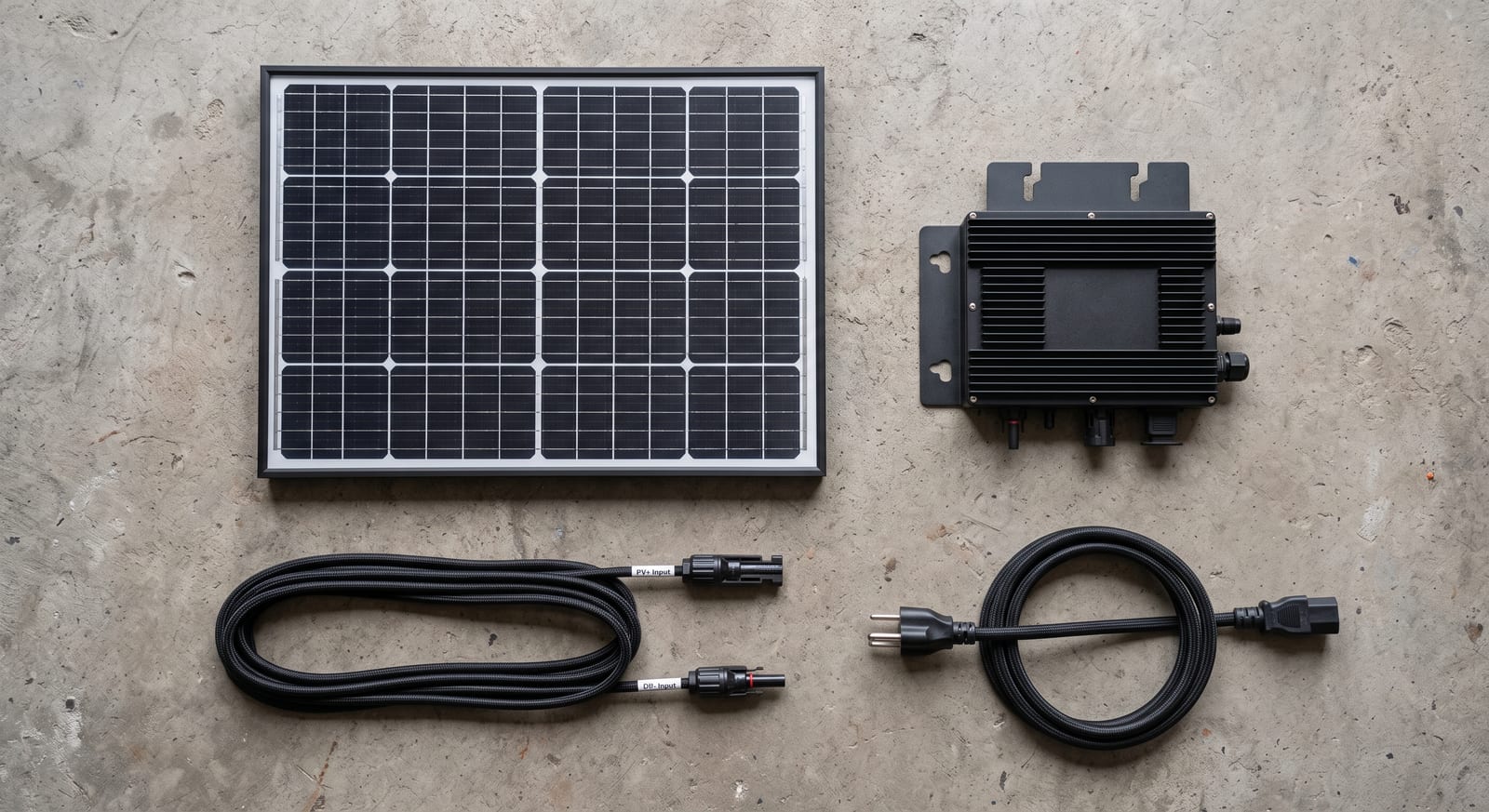
What is actually in one?
Four things, and only one of them is the panel.
A panel. About the size of a door and about as heavy as a bicycle. Sunlight hits the cells and produces direct current — the same kind a battery makes. A typical balcony panel is rated somewhere between 180 and 450 watts, which is its output in ideal noon sun, not what it makes all day.
A microinverter. A sealed box, usually mounted right behind the panel, that turns the panel's direct current into the ordinary 120-volt alternating current your home runs on. This is the expensive, clever, safety-critical part of the kit, and it's the component that has to be certified.
A cable and a plug. The microinverter's output ends in a standard plug. You plug it into an outdoor outlet the same way you'd plug in a string of lights.
Something to hold it up. Railing clamps, a folding stand, or a wall bracket, depending on where it's going.
How is it different from the solar on people's roofs?
It is a different product for a different situation, not a smaller version of the same purchase.
| Rooftop solar | Plug in solar | |
|---|---|---|
| What you buy | A construction project on your house | An appliance, in a box |
| Who can buy it | People who own the roof | Anyone with an outdoor outlet and some sun |
| Rough cost | Around $25,000 before financing | $285 to $2,400 |
| Who installs it | A licensed contractor, over several days | You, in an afternoon |
| Permit | Yes | No |
| Contract | Commonly a 20 to 25 year agreement | None |
| Share of a typical bill | Most of it | A slice — usually 10 to 20 percent |
| If you move | It stays with the building | It comes off the railing and goes with you |
| Backup in a blackout | Only with a battery and the right inverter | None, ever |
The honest framing: a roof produces far more power and can cover most of a bill. It also costs many times as much, takes weeks, and needs a roof you own. This is the other end of that, and it is not a replacement for it. The costs side by side →
What this does that a roof can't
The comparison above makes plug in solar look like the smaller option. On price and output it is. On everything else it is the only option, and those differences are worth more than they look.
You don't have to own the building. This is the whole point. Around 44 percent of Californian households rent, and for twenty years the answer to "can I get solar?" was no. It isn't no any more.
Nothing is signed. No twenty-year agreement, no lien on a property, no credit check, no salesperson at the door. You pay once and you own it.
Nothing is drilled. Railing clamps and a folding stand. Nothing is bolted to the building, nothing is cut into, and a landlord's most common objection has nothing to hold onto.
It's reversible in half an hour. Off the railing, into the car, onto the next balcony. A roof array is a permanent improvement to somebody else's asset — this is a possession, like a bike.
You can start small and find out. A $285 kit is a way to learn whether any of this works on your balcony before spending more. Nothing about rooftop solar can be tried.
It pays back in a few years, not decades. Because the purchase is small, the arithmetic is short. The full working →
What it won't do
Four things, said here rather than left for you to discover.
It won't cover most of your bill. A slice, usually 10 to 20 percent. If you want the whole bill gone you want a roof, and you need to own one.
It won't pay you for spare power. Anything your home doesn't use in the moment flows to the grid and earns you nothing. SB 868 is silent on export compensation, deliberately — which is why these systems are small on purpose, and why the next two sections matter more than the panel's rating does.
It won't keep anything running in a blackout. Not reduced power. None. There's a good reason, below.
It won't work everywhere. A north-facing balcony, or one with a building in front of it, may not clear $100 a year. The calculator says "Honestly? Probably not" when that's the answer, and it says it often. Which way does yours face? →
Where does the power actually go?
This is the part that confuses people, so here it is plainly. Electricity takes the shortest path to whatever is drawing it. When your panel pushes 300 watts onto the circuit and your fridge is drawing 150, the fridge takes it from the panel rather than from the grid. The utility's meter only measures what crosses it, so it simply records less.
If the panel is making 300 watts and your home only wants 100, the other 200 flows out to the grid. Under SB 868 you're paid nothing for it. That's not a loophole or an oversight you can work around — the bill is silent on export compensation, deliberately.
Why does it matter whether anyone is home during the day?
Solar makes its power in the middle of the day. Most households use their power in the morning and evening. The fraction of your production that your home happens to consume as it's made is the single biggest number in the whole calculation, and nobody ever asks about it.
A household where somebody works from home, or has a baby, or runs a pool pump, uses maybe 70 to 80 percent of what a small panel makes. A household that's empty from eight to six uses closer to 40 percent. Same panel, same sunshine, nearly double the difference in money.
This is why we ask it in the calculator and why we rate a café better than a house.
Chart description
A day from 5am to 9pm. A south-facing panel's output rises through the morning, peaks around 1pm, and falls to nothing by early evening. The utility's most expensive hours, 4pm–9pm, are shaded behind it and begin after production has largely finished.
What does a battery change?
A battery sits between the panel and the outlet. It soaks up the midday surplus you'd otherwise give away and releases it in the evening, when you're home and rates are highest.
| No battery | With a small battery (1–2 kWh) | |
|---|---|---|
| Share of production you actually use | about 60% | about 90% |
| Estimated annual saving, 1,200W in Irvine | ~$376 | ~$564 |
| Added cost | — | $800–$1,500 |
| Payback | 2–4 years | 4–6 years |
Estimated. Assumes 1,900 kWh a year from a tilted 1,200-watt system in Orange County and a 33-cent blended rate. Full working.
So a battery earns you more but pays back slower. It's worth it if you're on a time-of-use plan with a punishing evening peak, and it's the wrong purchase if you're mainly trying to find out whether any of this works for you.
In Germany, the only mature market for this, EcoFlow's own sales data shows the share of its balcony systems sold with storage doubled from 20 percent in 2023 to 40 percent in 2025. Buyers with a decade of experience increasingly conclude the battery is worth it. Whether it's worth it for you →
Is it safe on a normal household circuit?
This is the part the firefighters' unions and the electrical workers argued about, and it's worth understanding rather than glossing over.
Your outlet is on a branch circuit, protected by a 15-amp or 20-amp breaker. That breaker's job is to trip if too much current flows. Normally all the current on that circuit comes from your panel board, so the breaker sees everything.
A plug in solar device adds a second source of current, downstream of the breaker. In theory, with a large enough device and enough load on the same circuit, the wires could carry more current than the breaker is watching for. That's the "breaker masking" concern.
In practice, the 1,200-watt cap in SB 868 exists precisely to keep this well inside the margin, and the UL 3700 standard is written to test for it. Germany has over a million of these installed with no pattern of fires attributable to the devices. But it's a real engineering question, not industry noise, and the answer is: keep to certified equipment, keep to the wattage cap, and don't run a heater on the same outlet.
Why does it switch off in a blackout?
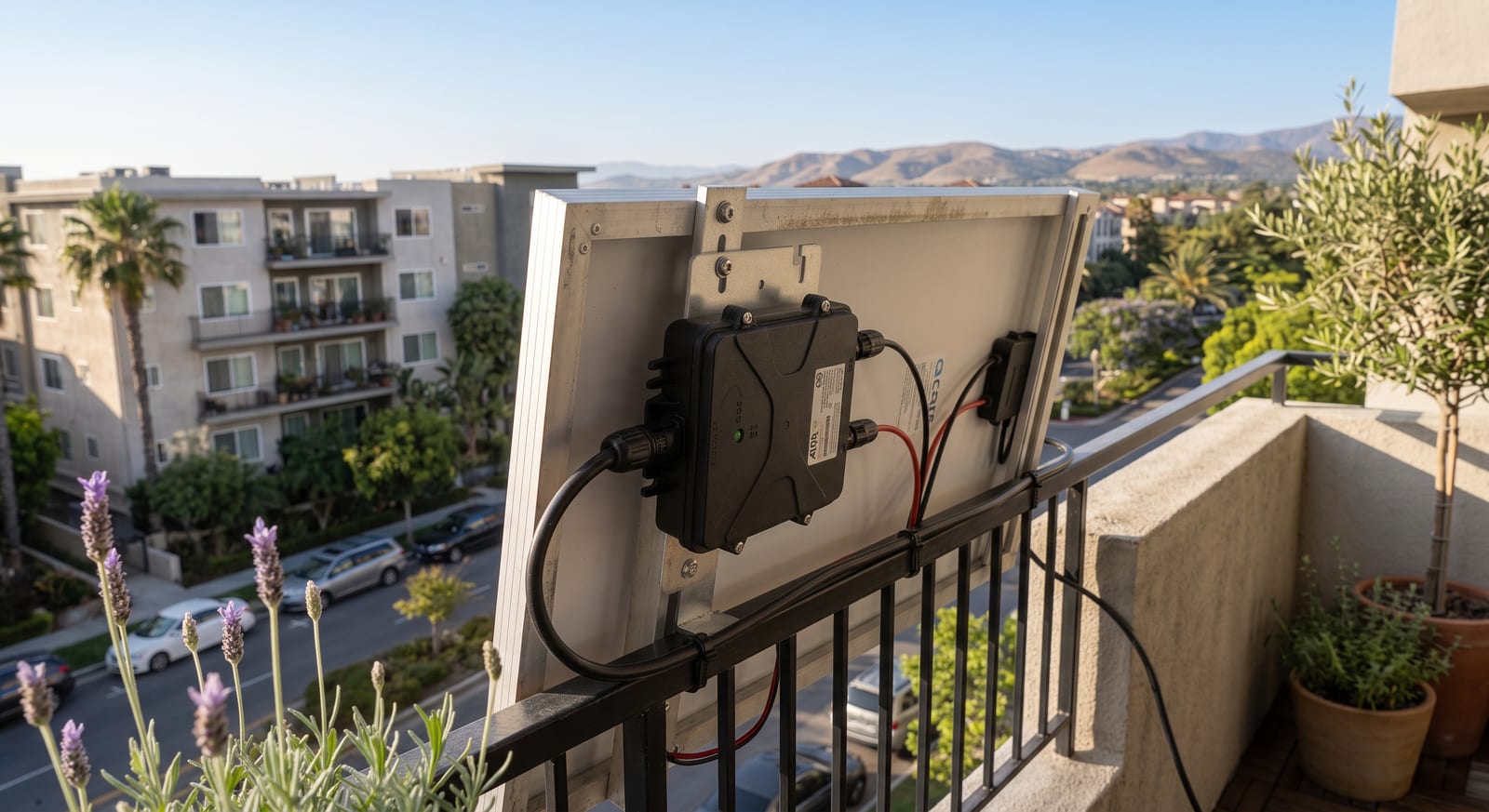
In plain terms: it switches off in a blackout. Every compliant device watches the grid and stops producing within a fraction of a second of it disappearing. Spec sheets call this anti-islanding.
The reason is line workers. If the power is out on your street and a dozen balconies are quietly pushing electricity onto the local wires, someone repairing those wires can be hurt. So the law requires the device to shut down, and it does.
The consequence for you: plug in solar provides zero backup power. Not reduced power, none. If you want the fridge running during an outage, you want a battery with a backup output, which is a different product with a different price.
What do you need before you buy one?
- An outdoor outlet, or a safe way to reach one. Running a cord through a sliding door is common and usually fine; running it under a rug is not.
- A railing, wall, or floor that can hold roughly 40 to 60 pounds and won't be damaged by clamps.
- Sun. A south or west aspect with a clear view of the sky. Which way does yours face?
- Permission, or at least no prohibition. Your lease and your HOA rules still apply. The honest version.
What's in a kit and what you'll also need →
Sources
Every legal, numeric and safety claim on this page traces to one of these.
- UL Solutions, UL 3700 Outline of Investigation for Interactive Plug-In Photovoltaic Equipment — accessed September 1, 2026
- SB 868 bill text, Public Utilities Code §8530 — accessed September 1, 2026
- Bundesnetzagentur, Marktstammdatenregister registrations of plug in solar devices — accessed September 1, 2026
- ESS News, EcoFlow German sales data on balcony storage attach rates — accessed September 1, 2026
- US Census Bureau, American Community Survey 2020–2024, California housing tenure — accessed September 1, 2026